AI compliance: good, fast, cheap
Collect evidence for AI Act and GDPR compliance with minimal effort. Questions are developed in collaboration with domain experts and are available in accessible language (no jargon). Optional AI assistance while completing assessments. 100% EU hosting.
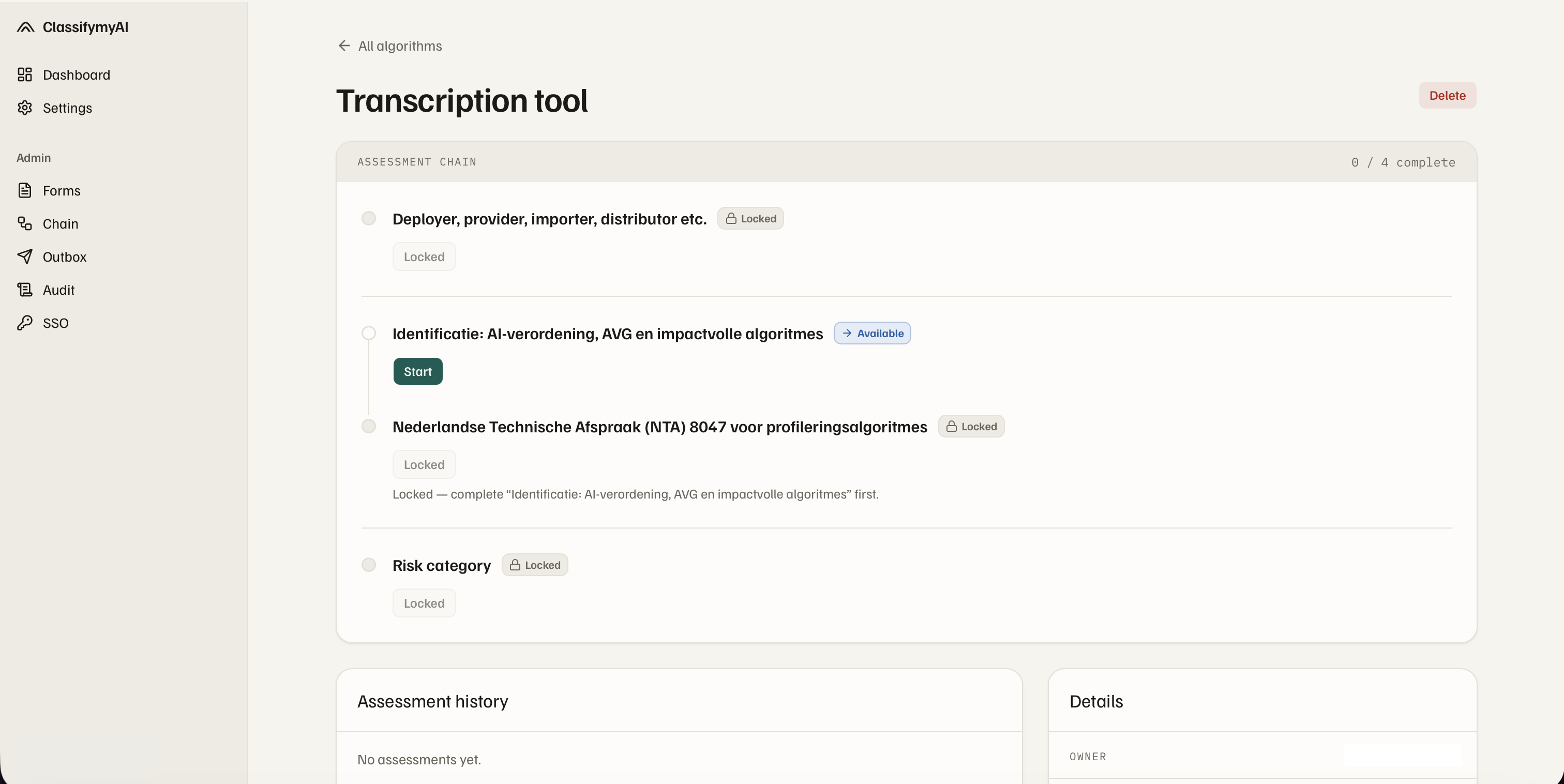
AI compliance made simple
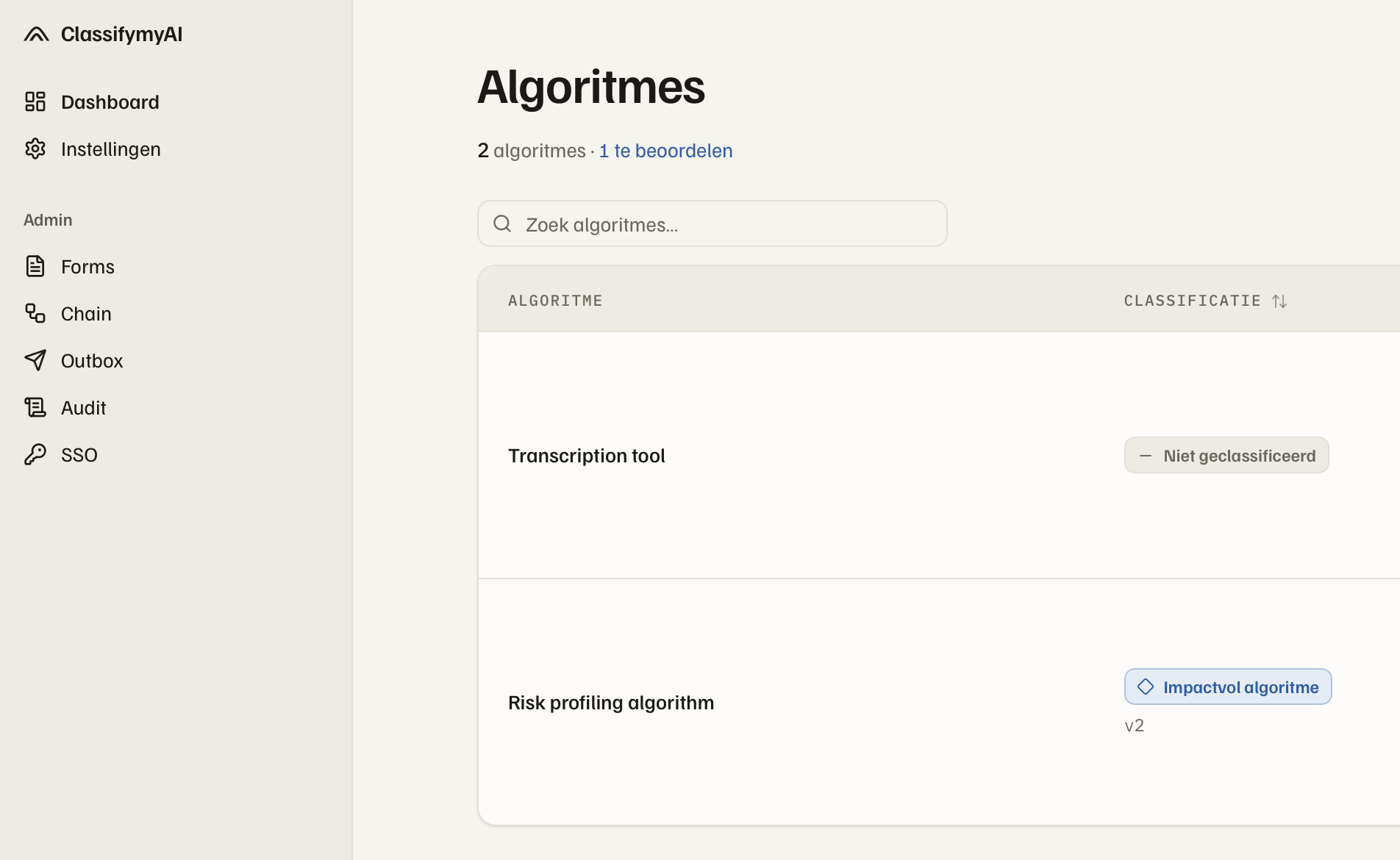
Inventory: Register applications within your organisation
One inventory of all applications your organisation uses: name, owner, what it does and its compliance status.
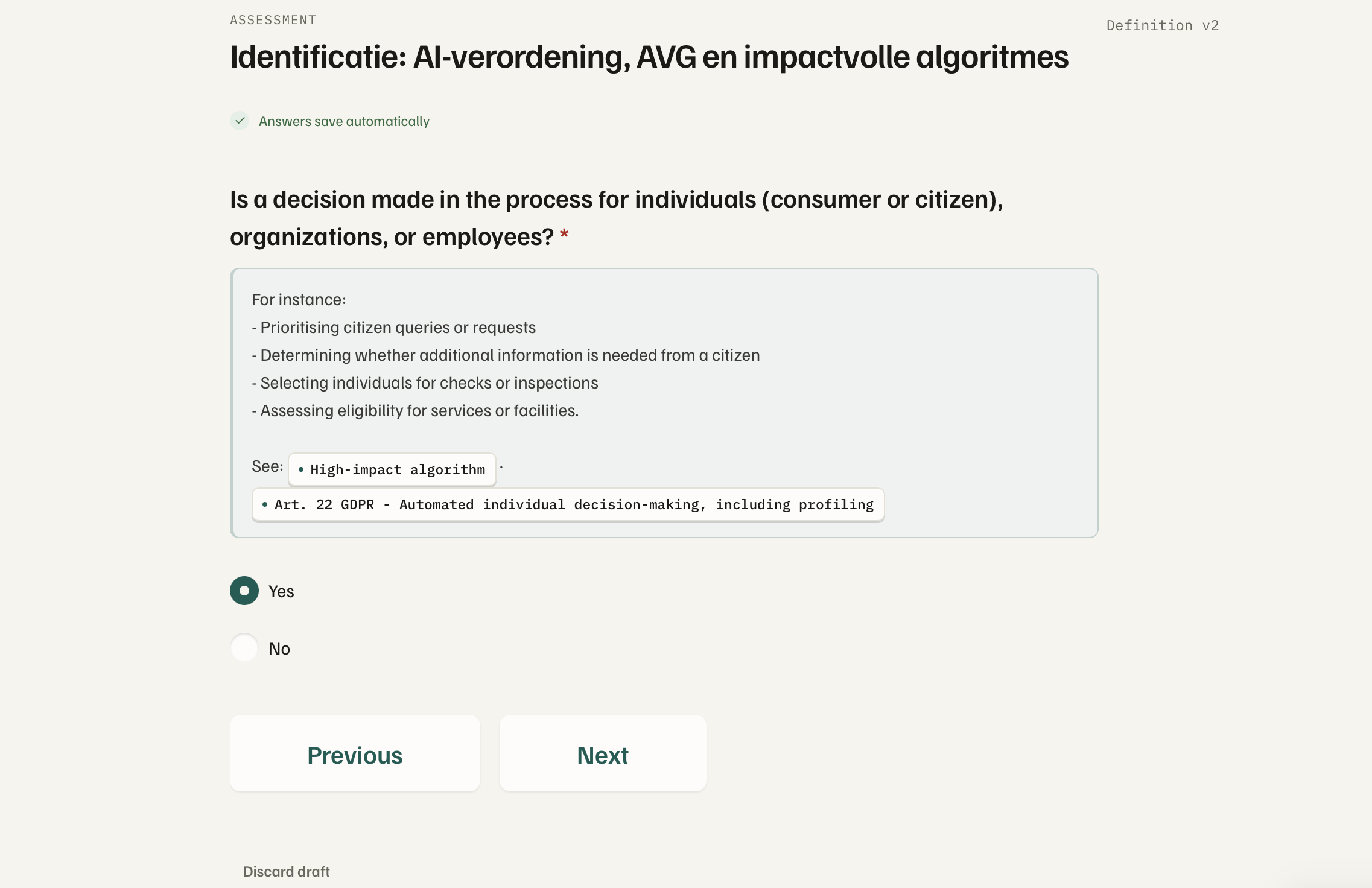
Answer questionnaires that adapt
Determine first under which laws and regulations an application falls (AI Act, GDPR, NIS2). Then, make use of templates that simplify compliance with the help of AI support.
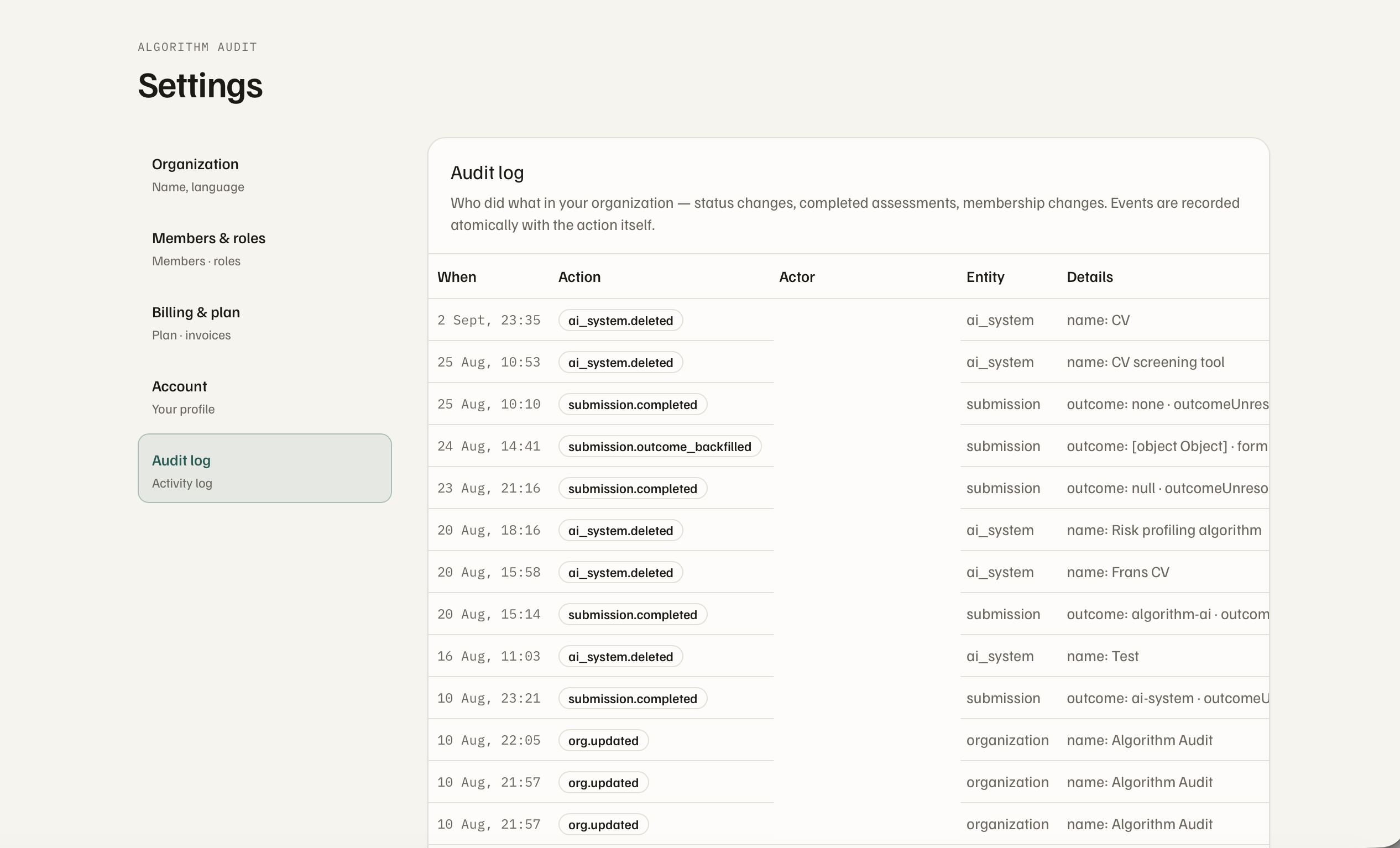
Compliance evidence you can hand over
Every completed assessment is versioned, timestamped and can be exported as a PDF. Ready for an internal or external audit.
One tool, multiple regulatory frameworks
Supported functionalities:
AI system definition (identification in max. 3 questions)
Role and status (provider, deployer, in use, in development etc.)
Risk category (high-risk or other)
Transparency requirements (art. 50 watermarking etc.)
Obligations (per role, status and risk category)
Risk management standardComing soon
Supported functionalities:
Personal data
Profiling
Solely automated decision-making
Record of Processing Activities
Pre-DPIA scanComing soon
DPIA templateComing soon
Supported functionalities:
Category A, B, C, D Netherlands Algorithm Register Guidelines
Registration in the Netherlands Algorithm Register (for public sector organisations)Coming soon
Supported functionalities:
Scope (essential or important entity, sector and size thresholds)Coming soon
Cybersecurity risk management measuresComing soon
Incident reporting obligations (24-hour early warning, 72-hour notification)Coming soon
Management body duties (approval, oversight and training)Coming soon
Developed in collaboration with Algorithm Audit
Questionnaires are developed and tested together with Algorithm Audit – a European knowledge platform for responsible AI.
The questionnaires are publicly available and subject to community feedback, which keeps them accurate and up to date.
What the tool does today, and what comes next
Overview of (soon available) features. The platform is continuously improved based on feedback from our launching partners.
Dynamic questionnaires
Standardised questionnaires make AI governance harmonized and scalable across your organisation. The questionnaires are dynamic, minimizing the effort needed to identify compliance requirements across various regulatory frameworks, e.g., the AI Act and the GDPR (with NIS2 and ISO coming soon). First-line product owners complete the questionnaires, second-line regulatory experts review the answers. Together they build a record of evidence for legal compliance.
Compliance templates
When it's decided under which regulatory frameworks applications fall, templates are available to fulfil compliance requirements. Templates are aligned with state-of-the-art materials in relation to the AI Act and the GDPR, and include:
- Data Protection Impact Assessment (DPIA)
- Quality of datasets, accuracy and robustness specifications
- Bias testing and human oversight
- Risk and quality management
- Cybersecurity specifications.
Model documentation and logging are built-in features of the platform.
Audit logs and export
Completed assessments can be exported per questionnaire as CSV and PDF to serve as compliance evidence. An export of the full organisation is available in JSON format, covering:
- All registrations
- Completed assessments per registration, including version history
- Compliance review statuses per registration
- Full audit log of platform usage.
Cross references
The GDPR and the AI Act overlap, among others regarding profiling, human oversight and the registration of applications (Record of Processing Activities). We've built synergies into our questionnaire flow to minimize the effort required to meet compliance requirements. Our questionnaires are dynamically linked, such that answers to one questionnaire can be reused in another, and the system automatically flags when a change in one questionnaire may require a review of another.
Filtering and dashboarding
Registrations can be searched using filters that can be customised per registration. A dashboard is providing an overview of every compliance journey.
Collaborative working and notes
Coming soonTag and assign questions to colleagues. They automatically receive a notification in their mailbox. You can also ask for online support by the ClassifymyAI team for specific questions. Notes below a question record why an answer was given, such that it can be reviewed by experts and reasoning survives the person who wrote it.
Sectoral user profiles
Coming soonShortcuts through the high-risk questionnaire for AI systems for a specific sector, such as HR, education or finance.
AI support
Coming soonSuggested answers based on what you have filled in and the documentation you upload, e.g., existing model documentation or an available Data Protection Impact Asessment (DPIA).
Monitoring of applications in production
Coming soonAPI integration with the monitoring you already run on applications in prodcution, from GitHub triggers to warnings about model performance and drift.
Scheduled re-assessment reminders
Coming soonPeriodic reminders to check whether a completed questionnaire is still current.
Prepare for the 2 December 2027 high-risk AI Act deadline
Start using ClassifymyAI today.
or send an email to beta at classifymyai.com